
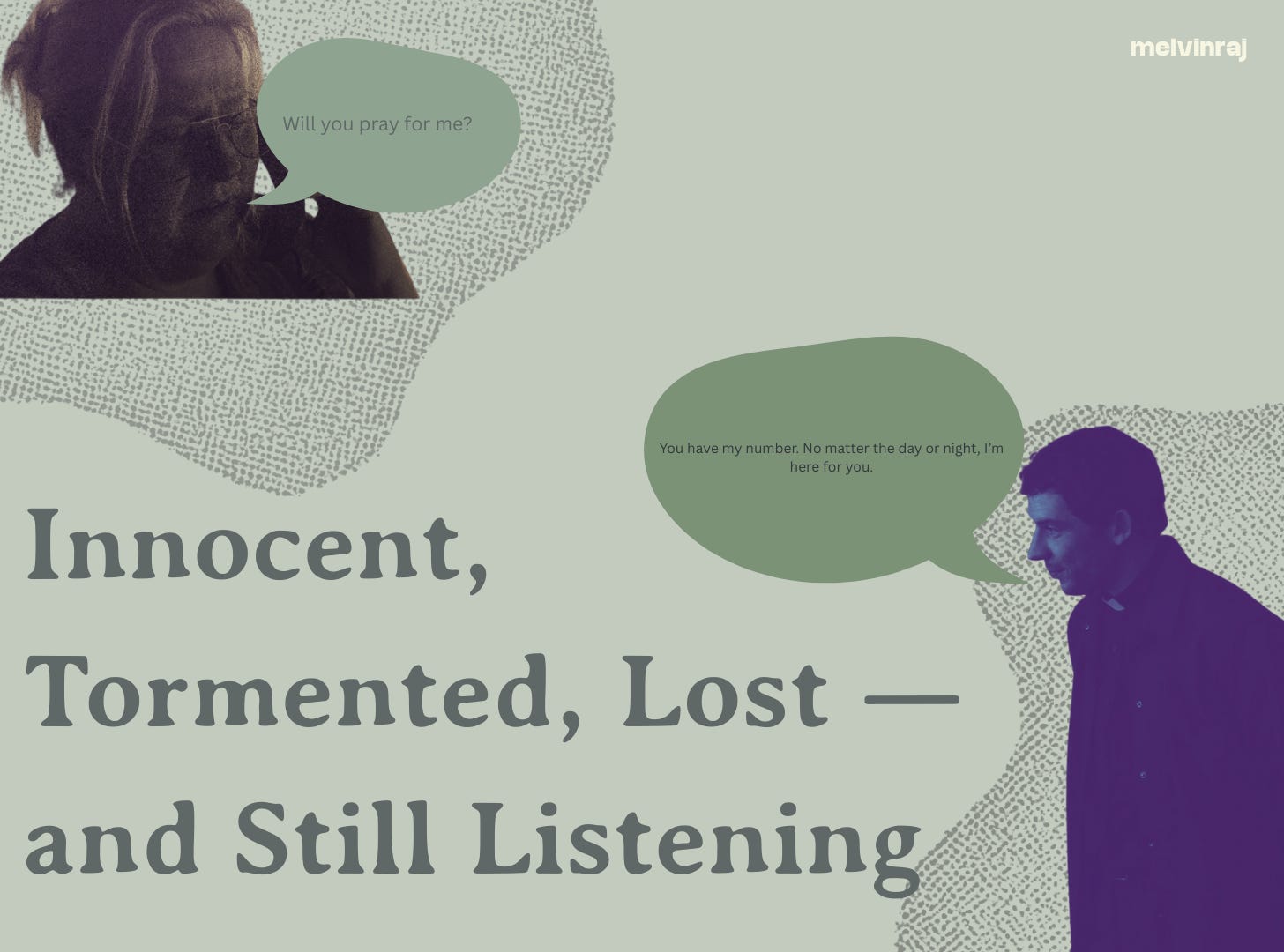
When Priest Jud calls the forklift company and speaks to Louisa on the phone, the voice, tone, and pace with which he asks information tells the urgency he has to find the person and help him prove his innocence.
When his urgency was met with random information that is not needed to him, he gets frustrated and then Louisa offers a call back when she gets the information.
As he tries to end the call, louisa says - “Will you pray for me?”
When his urgency is met with the pain she silently passed in those words, he realises what his purpose was and questions his actions all that while.
The line - “Will you pray for me?” from Louisa hits Jud on his purpose and the tone of urgency immediately drops and the inner priest comes out.
The calmness he brings is innate and has come from a lot of his process to be and do good.
Which probably is why the first time Benoit Blanc meets him he says the line -
“what I see is not a guilty man in torment; but an innocent man tormented by guilt. “
While watching the scene where the tone shifts - I had two thoughts
The quiet calmness in his voice hits harder than any noise and how he ends the call with louisa saying “you have my number, no matter day or night, I am here for you” is not something that only god can give but as a human who want to help others can provide other human beings and as he is a in the path of a priest, he calls to god.
The line Blanc says about Jud in the beginning when he first met and saw the goodness in him sets our minds in a positive note towards Jud and also shows how good of a detective blanc really is.
Watching this scene, I felt quietly confronted.
I tend to rush to provide my point of views, solutions or insights on their problems when people share something personal.
I offer thoughts, solutions, interpretations—often too soon. Maybe even before they’ve finished sharing their part.
Jud’s calmness reminded me that not everything shared is a problem waiting for my input. Sometimes, what people need is not clarity—but space. Space to be heard, to be seen as another human and to be present with them.
However, after hearing Jud say “I am here for you” - that gave me a sense of assurance that he will be someone whom I can share my troubles and felt heard.
To be that person for others—to be someone whose presence says “you can speak here”—feels like a personal achievement worth striving for.
Not for virality or for credits but as a human what can we give when we have nothing to offer but our shoulder to cry on, and our ears to hear other peoples problems.
I should not be jumping to put my 2 cents on their story and let them finish and more importantly not everything is a problem you have to solve.
Sometimes, the shoulder you offer gives more strength to fight their own battles than the solution you rush to provide.