
Empathy in A Beautiful Mind
Reflective notes on Empathy, understanding, mental illnesses after watching the movie A Beautiful Mind by Ron Howard.
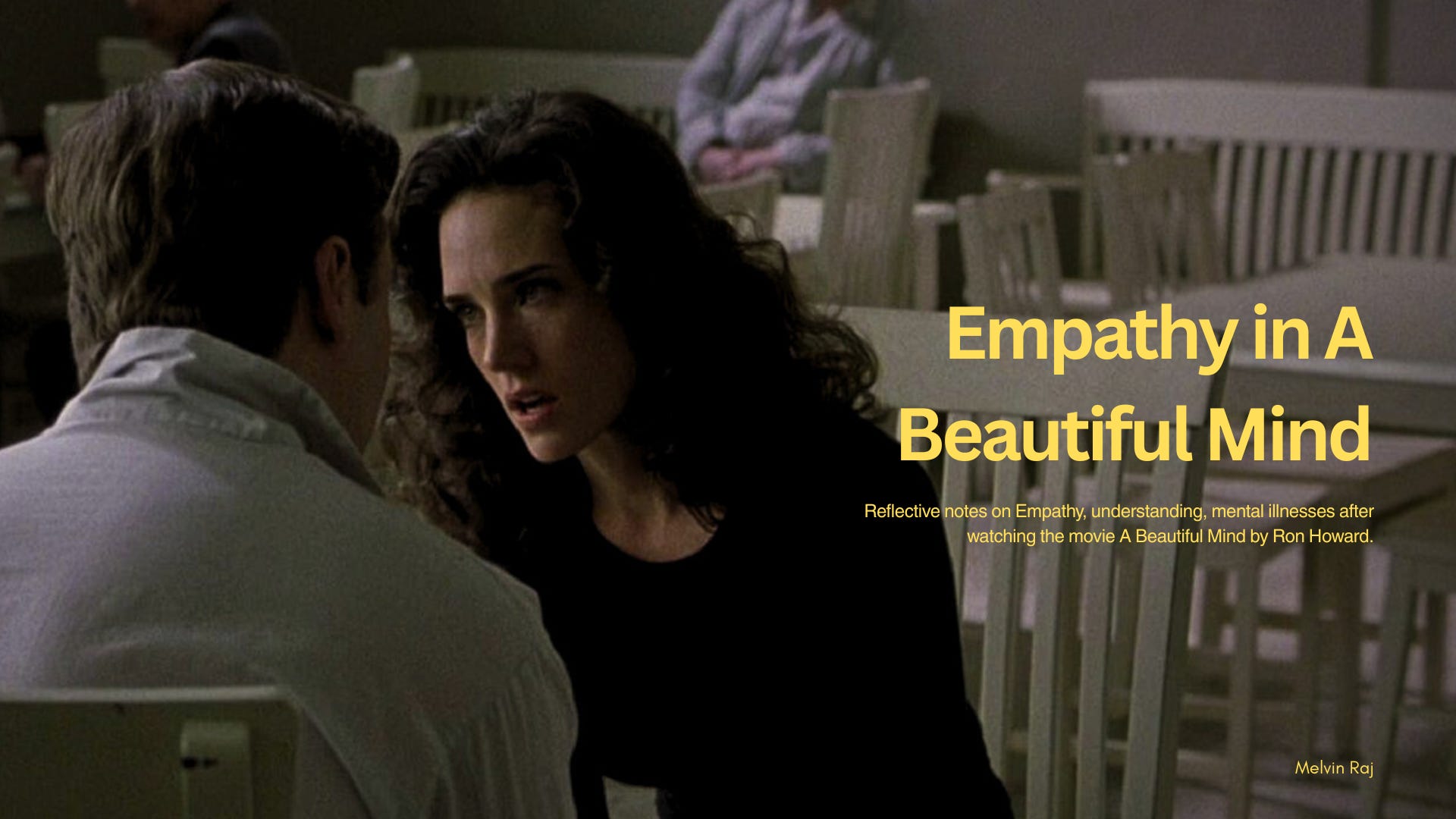
Everybody talks about the movie A Beautiful Mind and immediately praise the protagonist’s character for distinguishing reality from the mind’s games of a disorder that we still don’t fully have a cure for, but only a few notice the empathy shown throughout the film.
In the middle of his initial treatments for schizophrenia, the doctor tells Alicia: Imagine if you suddenly learned that the people, the places, the moments most important to you were not gone, not dead, but worse, had never been. What kind of hell would that be?
With this, Alicia understands his suffering. His beautiful mind has been playing tricks on him all along. So she stands by him and offers help gently. Nash does not believe what everyone tells him: that his roommate, his roommate’s nephew, and Parcher are not real. He is forced to battle it out alone, which in return was hurting his wife and child.
Yet he chooses to believe they are real, and that the Russian is after him for answers. As the days go by, his intuition and fears grow darker, and he isolates himself, causing his wife to fear for him.
The day he realizes that the nephew is not aging, he runs after his wife, who is about to leave out of fear, and tells her what he has discovered: the nephew he sees has not aged.
This subtle hint gives her the confidence that Nash is in his right mind, and she returns home to help him.
WhenNash speaks his mind about him being unsure of the things around him; she shows him what is real and touches his face, she reminds him that touch, people who age, and these tender gestures help him find direction and confirm what is real.
From then on, Alicia looks after him, and together they move closer to Princeton, believing that being near what Nash loves will help. Nash also reconnects with an old friend, shows empathy, and lets the friend stay and work from the campus library.
Slowly, we see him change. We see him confronting the people in his mind, telling them that the journey ends there and that he will not react to their convictions.
We see him talking to students outside the library, helping them grow, learn, and understand concepts, even as he learns to ignore his own intrusive thoughts and fears.
This change happened because Nash chose to fight but also because of the people people around Nash who were empathetic for someone who was suffering.
How often do we find such empathy in the world now?
The world has made progress in curing so many diseases that we forget cures come only after the disease is identified. Before that, empathy, being surrounded by loved ones, and the ability to find joy in what we love come first, and then come cures, treatments, and the rest.